Showing posts with label blog. Show all posts

Thursday, February 7, 2013

What’s the problem with your blog?


Stuart Brown writes in his article “What’s Wrong With My Blog?” about the common mistakes that bloggers make with their blogs. He writes, “Creating a blog is easy – but alas, building a readership is somewhat more difficult”. He goes on to make several suggestions on ensuring that you have enough content and selecting appropriate topics. But let’s say that you’re doing this and want to know how to make more improvements to your blog. How can you identify what is working on your blog and what is driving visitors away? How do you measure success for your blog?  In Web Analytics 2.0 , Avinash Kaushik suggests measuring success for a blogs and non-commerce sites by looking at Visitor behavior. He suggests studying what visitors to your site are doing and how they are interacting with your content. He suggests analyzing the following metrics to get more familiar with your site visitors.

     1) Visitor Loyalty

Avinash writes that, “Visitor Loyalty tells you how often Visitors visit your website during the reporting period”. By looking at the Visits per visitor report, you can understand one aspect of visitor behavior. The report will show you the number of visitors and the number of times they visited the site. This information can be useful because you can determine the number of visitors that have only visited your website once. If you have a large percentage of visitors that only visited one time, that may mean that they do not find the content relevant to what they are looking for or not engaging enough to keep them coming back to your site.

      2) Visitor Recency

“Visitor Recency will tell you how long it has been since a visitor last visited your website”, writes Avanish. He goes on to write that this will essentially “measure the gap between two visits from the same person to your website”.  In order to make this data usable, you will need to determine how often the content on the site is updated and to set your goals accordingly. If content is updated several times a day, you may consider having a large percentage of visitors that visited daily a success.

     3)   Length of Visit

Avinash writes that Length of Visit measures the quality of visit as represented by the length of a visitor session in seconds. He suggests looking at the distribution of visitors and the amount of time they are spending on the site. If you want to increase the length of time for each visit, ask yourself how to engage these visitors. He suggests that you may analyze what content that the visitors that spend the most time on the site are consuming, and where they are coming from.

     4)  Depth of Visit

In regards to the Depth of Visit, Avinash says that this metric measures the distribution of the number of pages in each Visit to the website. This report helps you understand the content consumption patterns of your Visitors.  This can be valuable as you can focus on what has been popular historically and avoid spending any time on producing content that visitors will not engage with.
By looking at these measurements, you should be able to determine what creates the most value to your blog and what doesn’t.


Sources
Kaushik, Avinash (2010). Web Analytics 2.0. Indiana: Wiley Publishing Co. 3.
What’s Wrong with my Blog  -  http://modernl.com/article/whats-wrong-with-my-blog

Saturday, January 26, 2013

I Wanna Blog for Money… Kind of


I want to start a business blogging.  I don’t want to write the blog.  I just want to piggy back off my buddy who was receiving over 1,000 daily visitors to his L.A. Lakers blog he wrote for fun.  He wasn’t trying to drive traffic to his blog and he sure hadn’t tried to monetize it.  My buddy stopped writing the blog shortly after starting it, but I know that he has the ability to create some powerful content and I thought, hey, why not try to make some money doing that?   So, I started poking around for information about monetizing a blog and found a few key insights worth noting.

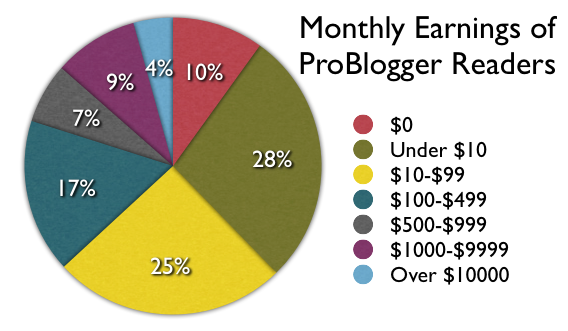
 Results of a survey of 1500 bloggers who subscribe to Darren Rowse's problogger

Lots of traffic does not equal money

You must have readership in order to make money blogging and increasing that readership should result in larger revenues– no argument there.  However, “more traffic” is not  a sufficient answer to how you can make money on your blog.  Sonia Simone provides an anecdote of when “Fake Steve Jobs” made little more than one hundred dollars on a day in which his traffic spiked to more than half a million visitors.  Contrast that with Anthony Feint who says he gets a “handy payment” on about 200 visitors a day.  Now, how much a “handy payment” equals is obviously unclear, but even if it were as little as ten bucks a day (and I’m sure it’s a whole lot more), you can see how favorably $10 for 200 visitors would compare to $100 for 500,000 visitors.  This leads to my next point. 

Banner advertising is NOT number one

One reason why Fake Steve Jobs could get half a million visits and potentially make less than Feint’s 200 visitor site is due to click through rate on banner advertisements.  Banner advertising begins to become lucrative as your click through rate increases.  What this means is that you don’t get paid a substantial amount of money until people begin clicking on the advertisements on your blog.  So even if lots of people are visiting your site, unless they are clicking on the advertisements you won’t be seeing much money. Feint wrote an article on how he increased his revenues ten-fold by simplifying his design to have fewer and more targeted advertisements.  Feint also utilizes affiliate programs who pay him for his recommendations.  Additional models include ideas from offering access to premium content for a paid subscription to landing paid speaking gigs as a result of your expertise established by your blog following.  It’s worth keeping in mind that you only see about half the revenue generated from ads when you utilize a provider like Adsense who keeps the other half paid by the client.  Check out David Risley’s Top 10 Blog Monetization Strategies, Ranked in Order for some other great ideas for how to monetize your blog (Risley puts Banner Ads at number 8).  

No one-size-fits-all

What works for one guy’s tech review blog might not work as well for another guy’s pet rescue blog.   Your choice of revenue stream should be dependent on the nature of your blog.  Donations may be a great revenue stream to consider for a blog regarding breast cancer awareness in which you clearly state a portion of the donations funds blog operations, whereas an affiliate revenue stream is worth considering if you review books.  Don’t be so much concerned with what the other guy is doing, but what business model makes sense for the content you are providing and the audience you are addressing.

My buddy doesn’t need me

I won’t be going into the blogging business any time soon. I'm not interested in providing content and if my friend wants to make money blogging he doesn't need me to do it.  If you are already blogging there are plenty of options to begin playing around with to monetize your site.  While Adsense may not be the most effective way to make money blogging it is probably the simplest.  You may not be able to quit your day job, but maybe you’ll be able to generate a nice supplemental income.  Just don’t let the quest to monetize your blog cause you to lose sight of why you started blogging in the first place.  

References:
2. Sonia Simone, "Why You Can't Make Money Blogging", viewed 1/26/2013.
3. Anthony Feint, "How I Increased Blog Revenue 10 Fold", viewed 1/26/2013.
4. David Risley, "Top 10 Blog Monetization Strategies, Ranked in Order", viewed 1/26/2013.


Friday, January 25, 2013

Crank the volume: Your blog with Infographics


This is your blog without Infographics:
Figure 1 - Few pictures or icons to look at...my eyes are tired. Text puts me to sleep.
This is your blog with Infographics:
Figure 2 - Infographics make pretty much anything interesting! Really. No. Really.
So now that you clearly see Infographics are really cool, so how do you go about creating them, or sourcing them from other authors? Keep reading. Here’s how it’s done:
  1. Visit a site like visual.ly and check out what they have. There are tons of existing Infographics that you can source or you can connect with a content creator and have your Infographic custom-made.
  2. Thinking graphically can get you way ahead of the game. You can also use office tools like PowerPoint to create your own Infographic, but there are some limitations. 
  3. You can overdo the Infographics, so make sure you keep your design tenets and guiding principles top of mind, and keep those colors and text in check.
  4. The key behind Infographics is they communicate detailed subjects very quickly and easily because they effectively combine graphics, icons, bullets or key points, typography (word art) and white space into all into a consumable format.
Guy Kawasaki is a master of Infographics. He uses his blog and site to communicate quickly and effectively on all kinds of topics. He links his tweets to his Infographics. It’s a fantastic model for using the medium. Click here to see a cool example. 

Besides Guy’s blog, there are a few other blogs and content sources that use Infographics effectively, like TechCrunch, Gizmodo, and Fast Company. A quick Google search can point you to many more.  The point is, if you’re not using Infographics in your blog, you’re missing out on the ultimate ‘interesting’ factor.  

In my research, I ran across a tool called Visualize.me that makes an Infographic for your resume and it can pull the data straight from LinkedIn. That’s cool! But, use with caution, it’s pretty edgy for most employers and recruiters.  Here's my personal version.