Showing posts with label PII. Show all posts

Tuesday, February 18, 2014

Who's Who: Cross-Platform Customer Identification

Customers want [and expect] relevant ads but want control over their data1 but how do we identify those customers and their preferences across multiple platforms?


Currently most industries are only using the two most common methods, PII (Personal Identifiable Information) and cookies.2   PII such as site authentication while highly accurate only applies to a fraction of site traffic – the authenticator must have an account and must be “logged in” to that account.  Cookies are device specific text files created by a site with data regarding that specific device and session, these files can be read by other web sites and are therefore able to provide data.

But what happens when we use more than one device and don't sign in all of them?

Device Usage
Courtesy of http://blog.limelight.com/2013/02/how-are-you-adapting-your-marketing-to-mobile/ 3
With the introduction of so many different devices a person may

  1. Read an email about a product on their phone on their way to work 
  2. On their work computer they begin researching the product using two different browsers
  3. At home they show their significant other on their tablet
  4. Finally before going to bed place the order on their personal desktop

From the business’s reference point they received a number of unique visits and a purchase with no prior browsing history.   

This scenario or something like it is common but how can this company connect the dots and deliver relevant content without knowing anything about the customer? 

This type of customer Forrester Research calls a PCC (Perpetually Connected Consumer).  In the US, by the end of 2012, 42% of online adults met the Forrester definition of PCCs, up from 38% in late 2011.  Globally, Forrester predicts that by the end of 2013, close to half of online adults will be perpetually connected.4

The way to identify this growing type of customer isn’t always clear for each business especially when considering a respective business’s current status on customer identification but one thing is for certain, a business will need more data, lots more. 

One suggested method is getting a DMP or data management platform.  Jack Marshall from Digday describes it as a data warehouse used for storing and analyzing information specifically pertaining to marketing.5 

Whether you build or buy you will be faced with the same concerns
  • Cost of implementation and data collection
  • Scalability
  • Privacy infringement 
Of those concerns arguable the most important is that of privacy, according to Visioncritcal.com privacy and big data are on a collision course. 6 While cost and system scalability can worked on internally how customers' data is used will be a reflection on the company. 


References 


1 Online Users Say They Want More Relevant Ads, But With Privacy Controls Attached. (2013, November 8). http://www.marketingcharts.com/wp/online/online-users-say-they-want-more-relevant-ads-but-with-privacy-controls-attached-38009/
2 3 in 10 Retailers Unable to Identify Customers at the POS. (2012, February 2).  http://www.marketingcharts.com/wp/direct/3-in-10-retailers-unable-to-identify-customers-at-the-pos-20948/
3 http://blog.limelight.com/2013/02/how-are-you-adapting-your-marketing-to-mobile/
4 O’Connell et al. (2013, August). Solving The Cross-Platform Targeting Riddle. http://acxiom.com/solving-cross-platform-targeting-riddle/
5 Marshall J. (2014, January 15). WTF is a data management platform?. http://digiday.com/platforms/what-is-a-dmp-data-management-platform/
6 Grenville A. (2013, December 4). Privacy and big data on a collision course. http://www.visioncritical.com/blog/big-data-collection-and-privacy-concerns

Wednesday, February 13, 2013

Online Privacy Laws for Countries

Now that I have done some thinking and writing about privacy concerns posed by Web Analytics (Oh and I need to make sure I use the right word, read article to see why), I was prompted to research on the privacy laws of different countries[1]. This was an interesting research, considering the various stages different countries are in the current web world. US, an obvious choice, EU & China are some that I have tried to research on for their internet privacy laws and provided some snippets here. 

Before jumping into the privacy laws, an interesting image I found online triggered an equally interesting thought. Does anyone associate themselves with this image based on the country he/she lives in? I don't, rather I cannot! Almost every country in the current web analytics world has most of their internet users tracked some way or the other. So, there is no way for us to think that we are the only ones in there. There is always someone "watching".

Picture Courtesy [2]: How many people do you think will ever feel this way in the current digital world?


While researching on privacy, I found an interesting analogy and thought to quote that as well[3]. This is an analogy of Google Analytics to privacy.


"A parent standing on a street corner counts the number of cars that drive pass a school gate. They are interested in safety and traffic flow. Hence they count the number of cars passing per minute, note their type e.g. car, SUV, buss, lorry etc., take a note of their speed and any other factors, such as weather and amount of day-light. All users of this particular section of road are effected by such data – the local commune, parents, children, teachers, commuters, shops and business, and delivery companies.

The observer has a legitimate reason to observe and measure traffic conditions and there are no privacy issues with this. No personal identifiable information (PII) is collected and traffic is reported in aggregate. That is, individuals are not tracked. This is how Google Analytics works."


Now looking at the bigger picture, privacy is split up as; 1. Personally Identifiable Information (PII) or 2. Non PII [4]. The non PII is used to track the trends or person's behavior on the website, which can help companies with several of their studies. Most countries have concerns with companies collecting the PII from customers without being transparent of not informing them about this data collection.

Let's start with one of the most intriguing growth stories of the past decade, CHINA. It is a different story when it comes to internet privacy here. It is not just the eCommerce or web analytics companies that track customer data, but it is the government [4] that wants to track online journey of its citizens. The Chinese government intends to control all or most of the web content usage and flow to ensure nothing against it is mentioned anywhere in the web world. An example of this would be the Chinese journalist, sentenced to 10 years of prison for having sent a "private email" with some of his views on Chinese government. Knowing this, I would probably think twice to browse internet if and when I go to China. 

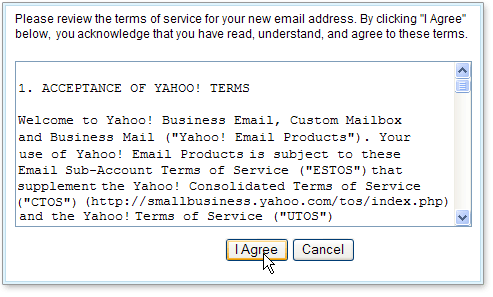
Coming to the other union of nations, EU, the recent EU privacy law does require companies to make its tracking more transparent by taking consent from the customer if they agree to have their data tracked/shared. How many of you would read through the entire terms of service when you download a software, make an online transaction or are even asked to sign/acknowledge before agreeing to them? Would we then even consider to read through the long terms of service detailing how our privacy is at stake if we agree to them?

http://us.i1.yimg.com/us.yimg.com/i/us/smbiz/gr/help/bm_accepttos.gif

Though a welcome sign by the EU to direct companies in taking customer consent before collecting their PII, how much of this new law would really reduce privacy intrusions will need to be seen... 

One would consider US to be a more "free" nation when compared to China. But, as I write this post, here is a latest update on the internet privacy law in the US. CISPA is being reintroduced by some leaders which would give access, to companies and government alike, to collect private customer data in the name of national security. To what extent would this bill be hampering the privacy of customers in the US? Do we need to be worried as to how our data will be used? One could argue that with the growing knowledge and concern of cyber security threats, it is in the best interest of the nation to have active tracking of individuals' online activities. But, where is the line that would define what level of tracking is actually needed for the purpose of identifying and controlling such threats? Has China, with its vast control of internet traffic, been able to control cyber threats/attacks? With the kind of technological advancements that we have achieved, is there any other way to keep track of online activities without needing to have private data.

References:
[1] Digital Analytics Association - http://www.digitalanalyticsassociation.org/?page=privacy
[2] http://glassboard.com/blog/2012/07/18/recent-privacy-policy-gains-hellooo-mobile/
[3] Advanced Web Metrics:Measuring success - http://www.advanced-web-metrics.com/blog/2012/10/04/privacy-web-analytics-google-and-ketchup/
[4] Wikipedia.org - http://en.wikipedia.org/wiki/Internet_privacy