Showing posts with label Digital Analytics Association. Show all posts

Monday, February 17, 2014

The Web Analytics Association to Digital Analytics Association

Figure 1: The Digital Analytics Association: Your Community, Your Collaboration, Your DAA


DAA Background 

The Web Analytics Association


Figure 2: WAA Logo
Sometime in the year 2003, three people came together in order to unite the individuals and organizations participating in analytical roles throughout the web industry. These three individuals, Jim Sterne, Bryan Eisenberg and Andrew Edwards all all joined forces with the purpose of creating an organization that would foster the Web Analytics industry [1], by allowing individuals to come together to accomplish and determine best practice methods for data acquisition, exploration, analysis and application. By 2004, the organization came to be known as the Web Analytics Association (WAA), providing individuals with the opportunity to add value through education, community, research and advocacy [2]. At the time, the WAA's scope was centered around analytical concepts and techniques related to website analysis. At this point in time, web analytics could be defined as data that has been captured and collected on an exclusive silo'ed data source. Some examples of early web analytics can include a marketing department analyzing their eCommerce trends, adjusting parameters as they see to best take advantage of the current trend. This basic type of web analytics pertains to associating data from one channel and source of traffic. The year 2011 would define a turning point in which the WAA recognized a new trend within the analytics world.


The Digital Analytics Association 


Figure 3: DAA Logo
2011 brought some change to how the WAA approaches analytics, mostly due to increasing use and wanted insight from external third party traffic sources. These third party traffic sources can include things like social media websites, forums and review websites. Through the transformation of Web 1.0 to Web 2.0, the WAA reacted properly, allowing them to maintain their foothold at the forefront of  the digital analytics industry. By adapting to this change, the Web Analytics Association re-branded themselves in 2011, becoming the Digital Analytics Association (DAA). The renewed mission of the DAA was to no longer silo off analytics to a single website, but rather to "...account for the analyst's changing role of weaving together data from multiple sources and channels" [2].


DAA Transformation

Web to digital transformation


The adaptation by the now DAA, shows its innate ability to understand the analytical industry. This adaptation allowed the DAA to stay relevant in the analytics industry as well as help provide input and training for organizations on how to use analytics in Web 2.0 as opposed to Web 1.0.

Figure 4: Web 1.0 vs. Web 2.0
When the WAA first started operating in the early 2000's, the internet was functioning in what we call Web 1.0. The concept of Web 1.0 dates to the early inception of the World Wide Web until sometime in the mid 2000's. Web 1.0 encapsulated websites that essentially could only be consumed, "content creators were few in Web 1.0 with the vast majority of users simply acting as consumers of content" [3]. For the most part, analytical power was centered on the main website page and web pages with the most traffic. In addition to this, analysis was was all mostly internally focused.

The change to Web 2.0 brought changes to how users not only absorb content but also react to content. One sided content pull has transformed into push/pull content generation and getting rid of old static web pages to allow for collaboration and interaction between internal and external users of your website. This two sided content exchange allowed for analysts to connect customer behavior to the bottom line of the company, by "...tie[ing] outcomes to profits..." [4].

The expansion of Web 2.0 brought on the creation of social networks, websites dedicated to allowing network like structures of individuals to communicate and exchange user generated content with one another. Types of social media mediums can include the following:
Figure 5: Social Media Websites
  • Forums
  • Blogs
  • Wikis
  • Social Networks
  • Podcasts
  • Videos
  • Pictures 
The shift in thinking of the DAA allowed for these external channels to be included within its web analytics standards. Their view on analytics now not only encompasses a website that has the most visitors or the web page that generates the most traffic but rather using all of these different channels, to create a single seamless digital footprint. This single footprint can then be used to see how web media is doing no longer as a part but in its entirety.

Leveraging the DAA 

What does the DAA provide?


Figure 6
So we have already gone through a basic rendition of what the Digital Analytics Organization is and how it came to be. With all of this general background information, I have not included information on exactly what the Digital Analytics Association provides. Ultimately, the DAA's value to the industry can be seen through its supplemental resources of:
  • Education
  • Community
  • Research
  • Advocacy 
Education includes the DAA provides individuals with online courses and certifications. Online courses are provided by the University of British Columbia, focusing in introduction to web analytics, site optimization, measuring online marketing campaigns and creating and managing business analytics culture.Certification for analysts is called the DAA Certified Web Analytists. This certification is a computer based test that allows individuals to demonstrate their expertise in best practices regarding web analytics.

The DAA community is similar to many other association communities in existence. The main purpose of the community imposed by the DAA allows for individuals and organizations to actively participate in helping shape web analytics standards. The DAA website states that through their communities, they are able to:
  • Offer group training and certification
  • Encourage institutions of higher learning to add web analytics to circula
  • Attemyp to unite web analytics professions to agree on
    • Standards
    • Definitions
    • Define and promote web analytics world wide [5]

Research is another thing that the DAA provides for individuals and organizations. The DAA is constantly researching and advancing their standards. New knowledge sources and industry trends are being published all the time. The DAA provides users with the Knowledge Center. This page on their website houses information related to new industry trends, current and developing analytics standards, hyperlinks to peer reviewed journals and other industry active blogs.

The DAA is constantly looking not only to its communities but also to the industry in order to form advcacy groups to put some standardization into web analytics. This can include holding public and private analytics based events, promoting higher ed institutions to the use of analytics in education programs and utilizing their industry power to advocate for standardization. 

The DAA and Future

What does the DAA have planned for the future?



Figure 7: The Future is Next
With Web 2.0 functionality currently in full effect, the current state of the Digital Analytics Association has adapted properly. With more and more social channels and mediums being used on the internet, analysts and organizations will need to constantly apply new Web 2.0 analytics standards recommended by the DAA in order to best add value to their bottom line. By attending current conferences and symposiums put on by the DAA, organizations and individuals will have the opportunity to have first hand knowledge with how the industry is currently acting and ways in which the industry can be moving. In addition to applying these concepts, analysts also need to be wary on how they can provide insight and help others understand what their are seeing. This ever evolving concept is something that the DAA needs to be at constant understanding with. By adapting standards and advocacy to new digital trends, analysis and analysis standards across the internet can become a coherent seamless tool that organizations can leverage to best add value to something that used to be so simple.

--------------------------------------------------------------------------------------------------------------------------------------------------------------------

[1] Waisberg, Daniel. "Web Analytics Association: A Special University." Online-Behavior. http://online-behavior.com/analytics/web-analytics-association-223, May 2010. Web. Feb. 2014.
 
[2] Facebook.com | Digital Analytics Association." Digital Analytics Association. https://www.facebook.com/digitalanalyticsassociation/info, Digital Analytics Association, n.d. Web. Feb. 2014.
 
[3] Cormode, Graham, and Balachander Krishnamurthy. "Key Differences between Web 1.0 and Web 2.0 | Cormode | First Monday." Key Differences between Web 1.0 and Web 2. http://firstmonday.org/ojs/index.php/fm/article/view/2125/1972, N.p., 15 Feb. 2008. Web. 17 Feb. 2014.

 
[4] Kaushik, A., Web Analytics 2.0: The Art of Online Accountability & Science of Customer Centricity Wiley, 2010

[5] Digital Analytics Association | Communities." Digital Analytics Association. http://www.digitalanalyticsassociation.org/committees, N.p., n.d. Web. Feb. 2014.

Figure 1: http://www.digitalanalyticsassociation.org/images/bg.jpg
Figure 2: https://blogger.googleusercontent.com/img/b/R29vZ2xl/AVvXsEhKZtYCpNxo5FPv2NhA-AhH0D8qYAWTZVhC-YE3UcABdWzqpNxAXq-F2xP4LaEtv9z617-tv_UStMXKTawSYWfo3zCQH0Ewd0ThvvTLiKepygzF6vEVID5b_2Wx4WPoJUTlF4xFCZSPH6k/s1600/web.png
Figure 3: https://blogger.googleusercontent.com/img/b/R29vZ2xl/AVvXsEhUs4J95NXAP8CTJq2hiIRbeRBoMx1mNV98gomgggE6tJrLgSN58x3uLhJlEVfqtzwbnYk2fFqWKDA2u-HfkIT7qwac0JAWvM7M4QPxM4BRot4qimNk8JIA8_krUn49NgVK5TWKfOdny2Q/s1600/digi.png

Figure 4: https://wemtech.wikispaces.com/file/view/web1vsweb2.png/101172389/web1vsweb2.png
Figure 5: http://directsitesonline.com/wordpress/wp-content/uploads/2013/09/online-social-media.jpg
Figure 6: https://blogger.googleusercontent.com/img/proxy/AVvXsEjzRpk0v-lLmCTbsItuLrORdis0hyphenhyphenFJcknE_1ILMenibFPw47PdS5boC6ltULGQSLT6CyZUt7Xzj2hL03Z0_UEFzWYwiwP9A9ligNvFgykRwpkPR2bwwQkv_IX9rimUDhfo7wxPcwoCMweM3xFLE18zhLmSuSMM65E=
Figure 7: http://www.greenbookblog.org/wp-content/uploads/2013/06/Future_Sign_Exit.jpeg

Wednesday, February 13, 2013

Online Privacy Laws for Countries

Now that I have done some thinking and writing about privacy concerns posed by Web Analytics (Oh and I need to make sure I use the right word, read article to see why), I was prompted to research on the privacy laws of different countries[1]. This was an interesting research, considering the various stages different countries are in the current web world. US, an obvious choice, EU & China are some that I have tried to research on for their internet privacy laws and provided some snippets here. 

Before jumping into the privacy laws, an interesting image I found online triggered an equally interesting thought. Does anyone associate themselves with this image based on the country he/she lives in? I don't, rather I cannot! Almost every country in the current web analytics world has most of their internet users tracked some way or the other. So, there is no way for us to think that we are the only ones in there. There is always someone "watching".

Picture Courtesy [2]: How many people do you think will ever feel this way in the current digital world?


While researching on privacy, I found an interesting analogy and thought to quote that as well[3]. This is an analogy of Google Analytics to privacy.


"A parent standing on a street corner counts the number of cars that drive pass a school gate. They are interested in safety and traffic flow. Hence they count the number of cars passing per minute, note their type e.g. car, SUV, buss, lorry etc., take a note of their speed and any other factors, such as weather and amount of day-light. All users of this particular section of road are effected by such data – the local commune, parents, children, teachers, commuters, shops and business, and delivery companies.

The observer has a legitimate reason to observe and measure traffic conditions and there are no privacy issues with this. No personal identifiable information (PII) is collected and traffic is reported in aggregate. That is, individuals are not tracked. This is how Google Analytics works."


Now looking at the bigger picture, privacy is split up as; 1. Personally Identifiable Information (PII) or 2. Non PII [4]. The non PII is used to track the trends or person's behavior on the website, which can help companies with several of their studies. Most countries have concerns with companies collecting the PII from customers without being transparent of not informing them about this data collection.

Let's start with one of the most intriguing growth stories of the past decade, CHINA. It is a different story when it comes to internet privacy here. It is not just the eCommerce or web analytics companies that track customer data, but it is the government [4] that wants to track online journey of its citizens. The Chinese government intends to control all or most of the web content usage and flow to ensure nothing against it is mentioned anywhere in the web world. An example of this would be the Chinese journalist, sentenced to 10 years of prison for having sent a "private email" with some of his views on Chinese government. Knowing this, I would probably think twice to browse internet if and when I go to China. 

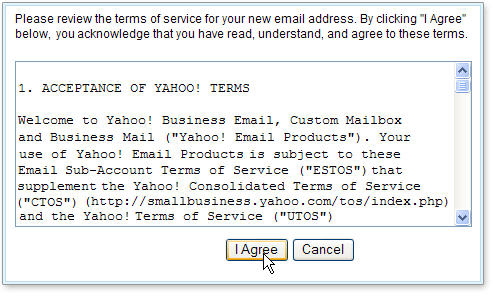
Coming to the other union of nations, EU, the recent EU privacy law does require companies to make its tracking more transparent by taking consent from the customer if they agree to have their data tracked/shared. How many of you would read through the entire terms of service when you download a software, make an online transaction or are even asked to sign/acknowledge before agreeing to them? Would we then even consider to read through the long terms of service detailing how our privacy is at stake if we agree to them?

http://us.i1.yimg.com/us.yimg.com/i/us/smbiz/gr/help/bm_accepttos.gif

Though a welcome sign by the EU to direct companies in taking customer consent before collecting their PII, how much of this new law would really reduce privacy intrusions will need to be seen... 

One would consider US to be a more "free" nation when compared to China. But, as I write this post, here is a latest update on the internet privacy law in the US. CISPA is being reintroduced by some leaders which would give access, to companies and government alike, to collect private customer data in the name of national security. To what extent would this bill be hampering the privacy of customers in the US? Do we need to be worried as to how our data will be used? One could argue that with the growing knowledge and concern of cyber security threats, it is in the best interest of the nation to have active tracking of individuals' online activities. But, where is the line that would define what level of tracking is actually needed for the purpose of identifying and controlling such threats? Has China, with its vast control of internet traffic, been able to control cyber threats/attacks? With the kind of technological advancements that we have achieved, is there any other way to keep track of online activities without needing to have private data.

References:
[1] Digital Analytics Association - http://www.digitalanalyticsassociation.org/?page=privacy
[2] http://glassboard.com/blog/2012/07/18/recent-privacy-policy-gains-hellooo-mobile/
[3] Advanced Web Metrics:Measuring success - http://www.advanced-web-metrics.com/blog/2012/10/04/privacy-web-analytics-google-and-ketchup/
[4] Wikipedia.org - http://en.wikipedia.org/wiki/Internet_privacy